
Most businesses don’t struggle to get testimonials because customers are unwilling. They struggle because they ask the wrong person, at the wrong moment, in a way that feels like homework. Satisfied customers are usually happy to share their experience; it reinforces their own good decision and helps other people choose well.
And the payoff is real: research from the Spiegel Research Center found that products with reviews can convert dramatically better than products without them, with lifts of up to 270% in their data. Testimonials work because buyers trust other buyers more than brands.
This guide shows you exactly how to ask for a testimonial without sounding pushy: a six-step system, the questions that produce persuasive answers, and copy-and-paste templates for email, text messages, social media and video testimonial requests.
How to Ask for a Testimonial: The 6 Steps at a Glance
- Ask at the peak moment, right after a result, a win or a compliment.
- Ask the right customers: promoters, repeat buyers and people who already praised you.
- Make it personal by referencing their specific project, product or result.
- Remove friction with one direct, mobile-friendly link and a time estimate.
- Guide the answer with two or three prompts instead of a blank page.
- Follow up once or twice, briefly and without pressure.
The rest of this guide explains each step and gives you templates for every channel.
Why Most Testimonial Requests Fail
Almost every ignored request comes down to one of three problems:
- Wrong timing. Ask too early and the customer hasn’t seen results yet. Ask too late and the emotion has faded, so your request becomes just another task in their inbox.
- Wrong customer. Mass requests to your whole list produce low response rates and vague answers like “great service.” The best testimonials come from people who have already shown they are happy.
- Too much friction. “Write us a testimonial” or “record a video and send it over” sounds like work. If the customer has to figure out what to say, where to submit or how to upload, they postpone, and later usually means never.
Fix those three things and asking for testimonials stops feeling awkward. It becomes a routine part of your customer journey.
What a High-Converting Testimonial Looks Like
Getting a response is only half the goal. The other half is getting a testimonial that actually helps the next buyer decide.
Weak testimonial: “Great service, highly recommend!” It is pleasant but vague, and it doesn’t answer any question a buyer has.
Strong testimonial: “Before working with them we struggled to generate consistent leads and had tried two agencies with no clear results. Within 60 days we were getting qualified inbound leads every week, and our cost per acquisition dropped by 35%.”
The strong version follows a simple structure that mirrors how people make decisions:
- Problem: what the customer was struggling with before
- Decision: why they chose you over other options
- Result: what changed, ideally with a specific detail or number
A prospect reading it thinks: that is my problem, that is the decision I’m making, and that is the outcome I want. Design your request so it produces this kind of answer.
The 6-Step Framework to Ask for a Testimonial
Step 1: Ask at the Peak Moment
Improve your timing before you improve your wording. The best moment is when the value of your product or service feels immediate and real. Build your requests around trigger moments in the customer journey:
- Right after a measurable result or milestone
- After onboarding or delivery is completed smoothly
- After a support interaction that solved the problem
- After a renewal, repeat purchase or five-star review
- When a customer praises you unprompted (“this was exactly what we needed”)
Typical trigger points by business type:
- SaaS: after a customer reaches their first key outcome, or 30 to 60 days after onboarding.
- Ecommerce: a few days after delivery, once the product has been used.
- Agencies and consultants: right after a project milestone or a results report.
- Events, venues and hospitality: on the spot, while guests are still enjoying the experience.
- Local services: immediately after the job is finished and the customer has said thank you.
We explore this in depth in why the moment you ask changes what customers say.
Step 2: Ask the Right Customers, Not Everyone
Testimonial requests are not a numbers game. Instead of emailing your whole list, look for signals of positive intent:
- NPS scores of 9 or 10
- Repeat purchases or long-term usage
- Positive reviews, emails, chat messages or social comments
- Referrals and word-of-mouth mentions
These customers respond more often, and their answers are naturally more detailed and persuasive. Instead of asking “who can I send this to?”, ask “who already believes in what we do?”
Step 3: Make the Ask Personal
A request that reads like it went to hundreds of people gets treated that way. Anchor your message in the customer’s real experience:
- Reference the product, service or project they used
- Mention a specific result or moment
- Acknowledge the relationship (“working with you and your team”)
- Explain in one sentence why their words would help others
Instead of “Would you mind leaving us a testimonial?”, try: “We loved working with you on the spring campaign, especially seeing your bookings jump. Would you be open to sharing a few words about the experience?” Personalization doesn’t mean writing every message from scratch; it means one sentence that proves you are talking to them.
Step 4: Reduce Friction to Zero
Make responding easier than ignoring. In practice:
- One direct link: no searching, logging in or navigating.
- A time estimate: “takes about a minute” beats “share your thoughts.”
- Mobile first: most people will respond from their phone.
- No technical steps: no app downloads, file uploads or editing.
This matters most for video. Customers are not creators; they won’t open editing tools or send large files. They will tap a link and record a short answer if it feels simple. A testimonial collection tool like Vidlo lets customers record from their phone through a link or QR code, guided by your prompts, and sends every video to one dashboard.
Step 5: Guide the Response
“Tell us about your experience” leaves the customer staring at a blank page. Give them two or three prompts that follow the problem, decision and result structure:
- What problem were you trying to solve before you found us?
- What made you choose us over other options?
- What changed after working with us?
- Did you have any hesitation before buying? What would you tell someone who feels the same?
Prompts make it easier to respond and naturally produce stronger, more consistent testimonials. For a longer list, see our testimonial questions that get high-quality responses.
Step 6: Follow Up Like a Human
Many testimonials come from the follow-up, not the first message. People get busy and messages get buried. Send one short, friendly reminder after three to five days, and a final one about a week later if needed. Two follow-ups are usually enough. Keep the tone light: acknowledge their time, repeat the link, and make it easy to say no.
Testimonial Request Email Templates
Use these as a starting point and personalize at least one sentence. Replace everything in brackets.
1. Request for a testimonial from a client (services and B2B)
Subject: Would you share a few words about [project]?
Hi [First name],
It was a pleasure working with you on [project]. Seeing [specific result, e.g. your sign-ups double in March] was a highlight for our team.
Would you be open to sharing a short testimonial about the experience? It helps other [industry] teams understand what working with us is like. A few sentences or a one-minute video is perfect, and you can use these prompts:
1. What challenge were you facing before we started?
2. Why did you decide to work with us?
3. What has changed since?Here’s the link: [link]
Thank you, and no pressure at all if now isn’t a good time.
[Your name]
2. Post-purchase testimonial request (ecommerce)
Subject: How is your [product] working out?
Hi [First name],
It’s been a week since your [product] arrived, and we’d love to hear how it’s going. If you have a minute, could you share your experience? Your words help other customers choose with confidence.
Share it here (takes about a minute): [link]
As a thank-you for your honest feedback, here’s 10% off your next order: [code]
The [Brand] team
3. Short, low-friction request
Subject: Got 60 seconds?
Hey [First name], quick one: would you be open to sharing a short testimonial about your experience with us? It takes about a minute: [link]
Really appreciate it!
4. Video testimonial request email sequence
For video, a three-message sequence works best: ask permission first, then send the link with instructions, then remind.
Initial email
Subject: We’d love to feature you!
Hi [First name],
We’re so glad you’re part of the [Brand] story, and we’d love to share your experience with our community in a short video.
Would you be up for recording a quick video in the next two weeks? It only takes a minute, and you can record from your phone or laptop with no app to download.
Just reply yes and I’ll send the link and a couple of questions.
Thanks so much!

Follow-up email (after they say yes)
Subject: Your featured video
Thank you for agreeing to record a video! It should take two minutes at most. Here’s your recording link: [link]
The question we’d love you to answer: How did [product] change or help your day-to-day?
Quick recording tips:
1. Pick a quiet, well-lit spot.
2. Avoid bright light directly behind you.
3. Look at the camera, not the screen.
4. Relax and be yourself; there’s no script and no need to be perfect.Let me know if you have any questions, and thanks again!

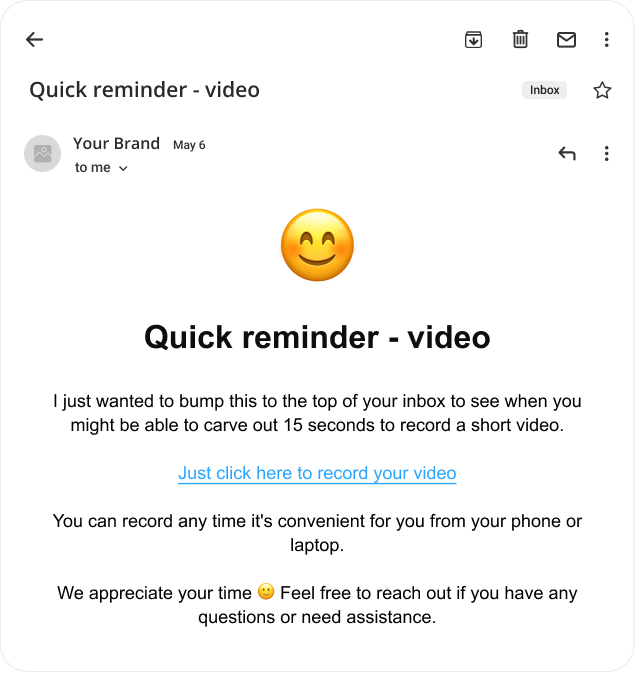
Reminder email (if you don’t hear back)
Subject: Quick reminder: your video
Just bumping this to the top of your inbox in case you can carve out a minute to record. Here’s the link again: [link]. You can record any time that suits you, from your phone or laptop.
Thanks for your time, and feel free to reach out if you need help.
Subject line ideas that get opened: “Quick favor?”, “Got 60 seconds?”, “Can we feature you?”, “Your story could help others”, “How did [project] go?”
SMS and Text Message Templates
Text messages feel direct and personal, which makes them ideal for local businesses, events and ecommerce. Keep them shorter than emails.
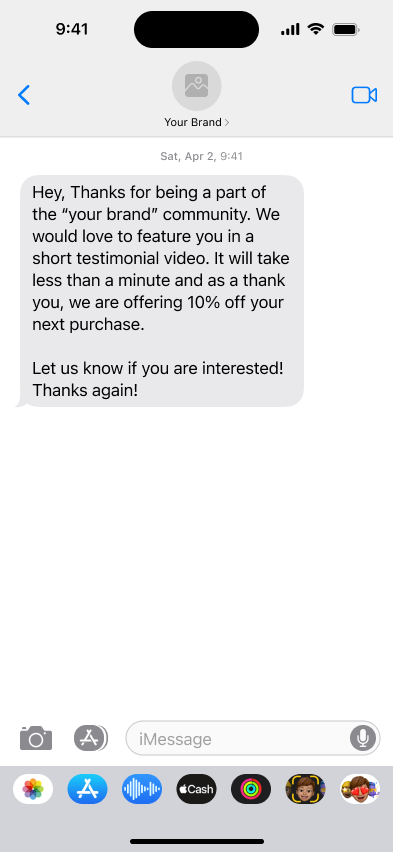
Initial text
Hi [Name]! Thanks for being part of the [Brand] community. We’d love to feature you in a short testimonial. It takes less than a minute, and as a thank-you we’ll send you 10% off your next purchase. Interested?
Follow-up text (after they say yes)
Amazing, thank you! Here’s your link: [link]. The question we’d love you to answer: “How has [product] helped you?” Once your video is in, we’ll send your discount code.
Reminder text
Hi [Name], just checking in. Would still love to hear your story if you’re up for it: [link]. No pressure at all!
Social Media and Direct Message Templates
Public post
We love hearing from our customers! If [product/service] made a difference for you, we’d love for you to share your story. Record a quick video or leave a few words here (takes under a minute): [link]
Direct message
Hi [Name], thanks so much for the kind words about [product] in your post! Would you be open to sharing that in a short testimonial we can feature? It only takes a minute: [link]
Asking In Person and With QR Codes
Some of the best testimonials are captured on the spot. Put a QR code on packaging, receipts, table tents, posters or event screens so customers can scan and record while the experience is fresh. Train staff to mention it at the right moment: “If you enjoyed today, we’d love a quick video; just scan this.” Our QR code video feedback guide covers placement and wording.
How to Ask for Video Testimonials Without Making It Awkward
Customers don’t resist video; they resist the way it is asked. Three changes make a big difference:
- Drop the word “testimonial.” “Would you record a quick video about your experience?” sounds casual and doable; “testimonial” sounds formal and high-stakes.
- Lower the production bar. Tell people that 30 to 60 seconds is perfect, that there is no script, and that a phone is all they need. Slightly imperfect videos often perform better because they feel honest.
- Make it mobile first. Tap a link, open the camera, answer the prompts, done. Every extra step costs responses.
With Vidlo, customers record directly in the browser from a link or QR code, see your prompts on screen, and their video lands in your dashboard ready to share. Brands can also let customers post their video straight to TikTok, which turns a testimonial into free reach.
Get Permission Before You Publish
Always confirm how you will use a testimonial, especially for ads. Collect consent with each submission, keep a record of it, and honor removal requests. Our guide to video testimonial consent and release forms explains what to include. If you offer an incentive, make it a thank-you for honest feedback rather than for positive feedback, and disclose it where you publish the testimonial.
Common Mistakes When Asking for Testimonials
- Asking before value is clear. Wait for a result or milestone, not just a purchase.
- Sending a generic mass request. No context means no reason to respond.
- Leaving a blank page. Without prompts you get “great service!”
- Making it hard. No direct link, unclear instructions or upload steps kill responses.
- Never following up, or following up too aggressively.
- Collecting testimonials and never using them. Put them where buyers hesitate.
Where to Use Your Testimonials
Place testimonials where doubt peaks: near the main call to action on landing pages, on pricing and checkout pages, on product pages that match the testimonial’s topic, and in ads, where real customer videos often outperform brand creative. A dedicated testimonial page helps too; see these testimonial page examples and our guide on how to display testimonials on a website.
Once you know how to ask, the next step is to stop asking manually. Automated testimonial requests trigger at the right moment for every customer, so your library keeps growing without extra work.
Frequently Asked Questions
How do you politely ask for a testimonial?
Thank the customer, mention the specific project or result you are proud of, explain in one line why their words would help others, and give a direct link with a time estimate such as “takes about a minute.” Keep it short, personal and easy to say no to; that is what makes it polite.
How do you ask a client for a testimonial via email?
Send a short email right after a clear win. Use a specific subject line, reference the work you did together, ask two or three guiding questions, include one direct link, and send a single friendly reminder after three to five days if you don’t hear back. The templates above cover the initial request, the follow-up and the reminder.
What should I write in a testimonial request?
Include five things: a personal greeting, the specific experience you are asking about, why their feedback matters, two or three prompts so they know what to say, and a single link with a time estimate. Leave out long explanations and anything that sounds like a mass email.
When is the best time to ask for a testimonial?
Right after a positive moment: a result is achieved, onboarding is completed, a support issue is solved, a repeat purchase happens, or the customer praises you unprompted. The experience is fresh and the emotion is still there, so answers are stronger and response rates are higher.
Should you offer incentives for testimonials?
A small thank-you, such as a discount or gift card, can lift response rates, but it must never depend on the testimonial being positive, and incentivized testimonials should be disclosed. In the US, the FTC treats conditioning rewards on positive reviews as deceptive, so offer the incentive for sharing an honest experience, not a good one.
Are video testimonials better than written testimonials?
Video usually builds more trust because viewers see a real face and hear a real voice. Written testimonials are faster to collect and easy to place anywhere. Offer both and let customers choose; see our comparison of video testimonials vs written reviews.
How long should a testimonial be?
A few clear sentences for written testimonials, and 30 to 90 seconds for video. Focus on the problem, the decision and the result rather than length. More detail on video length is in our guide to how long a video testimonial should be.
Start Collecting Better Testimonials
Asking for a testimonial isn’t about finding the perfect words. It’s about asking the right customer at the right moment, making it effortless to respond, and guiding them toward a story that helps the next buyer decide. Use the templates above, and if you want customers to record video testimonials from a simple link or QR code, try Vidlo free.